
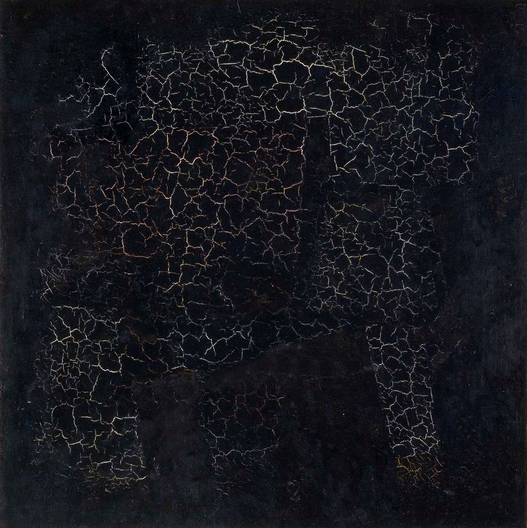
Black Square, 1915 by Kazimir Malevich

Untitled, 1969 by Mark Rothko
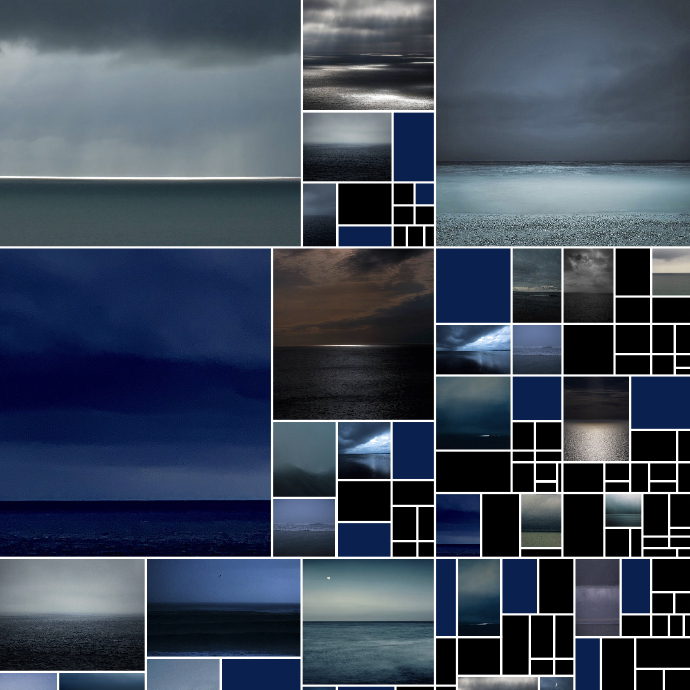
TickerArt, 2024 by Young Kim (324.3″ × 260.6″)
TickerArt Preface: Return to the Zero State
The Quantum Rituals of the Ticker and the Future World.
In the early twenty-first century, we entered an age where the ticker—once the neutral sign of financial markets—became the central metaphor of existence. Once, a ticker was merely a stream of numbers across a screen, recording the price of a stock. Today, it measures the heartbeat of our daily lives: credit scores, health indices, social rankings, biometric data. Each of us is quantified, reduced, and redefined by fluctuating values that rise and fall second by second.
Yet these values are no longer fixed. With the arrival of quantum computation, the ticker has absorbed indeterminacy itself. What once appeared as solid numbers are now revealed as probabilistic shadows, shimmering between potentialities. The age of certainty has ended. We live, instead, in waves of unstable probabilities—a condition that 20th-century existentialism could neither foresee nor answer. Sartre’s lonely freedom, Camus’ absurd rebellion, the heroic weight of the solitary subject: all dissolve in the face of data streams that bind us to billions of others in real time.
Black Square, 1915 by Kazimir Malevich
Untitled, 1969 by Mark Rothko
WHAT IS TICKER ART?
TickerArt was born in this collapse. It does not represent the world as it is, but as it fluctuates. It is art that treats volatility, noise, and probability as its primary pigments. Its canvas is not static but trembling, entangled with invisible currents of information.
Ticker Art transforms financial market data into living visual compositions. Each morning when markets open, colors surge across the screen: green spreading like hope, red bleeding like anxiety, or the two locked in battle. Each square represents a company. Each color shift marks a change in value. Each moment exists only once, never to return.
This is not data visualization. It is the emotional texture of markets made visible. Markets are not machines; they are minds. They panic and rejoice, remember and forget. They operate through waves of sentiment that ripple across continents in milliseconds. Ticker Art reveals this collective consciousness, bypassing analysis to touch something deeper.
THE ARTISTIC FOUNDATION
The practice builds on a century of artistic innovation. From Kazimir Malevich’s reduction of form to pure geometry, releasing the square from representation. From Mark Rothko’s color fields as direct emotional transmission, now set into motion, breathing in real time. And from quantum mechanics, recognizing that observation is never neutral: that watching changes what is watched, that you are not outside the system but entangled within it.
Every installation is unique. The algorithm is the same, the data identical, but the market never repeats. Some days green dominates. Other days red overwhelms. Most days they battle, creating patterns of surge and collapse, confidence and doubt. The screen becomes a mirror reflecting not just numbers but the hopes and fears of millions, condensed into pure visual form.
THE EXPERIENCE
To experience Ticker Art is to confront a paradox: that algorithms and data can touch you emotionally, that numerical abstraction becomes aesthetic experience, that watching numbers feels like witnessing something alive. This paradox reveals a truth about our condition. We live immersed in data, surrounded by screens, our existence measured and quantified. Ticker Art does not resist this. It transforms it into contemplative experience.
The practice asks you to slow down. Ten minutes of attention. No analysis. No predictions. Just presence. Watch colors shift. Watch forms evolve. In that presence, you begin to feel the pulse beneath the surface. You recognize your complicity in what you observe. You understand, not intellectually but viscerally, that you are not separate from what you watch. Your attention is part of the system. Your presence completes the work.
zasTicker Art exists only in the moment of observation. Live. Now. Unrepeatable. These colors reflect decisions being made at this instant by real people across the world. You are witnessing the present moment of global collective consciousness crystallizing into visible form.
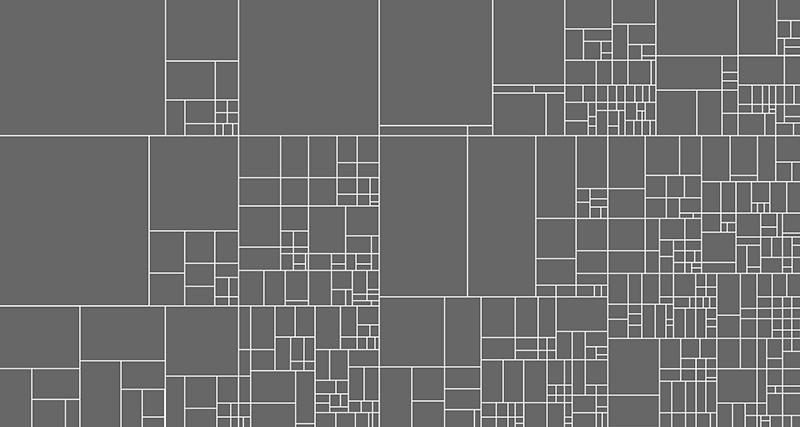
The tension of the stop on the 9:30 timeline, 2024 by Young Kim

Color plane abstraction of quantum dots, 2024 by Young Kim
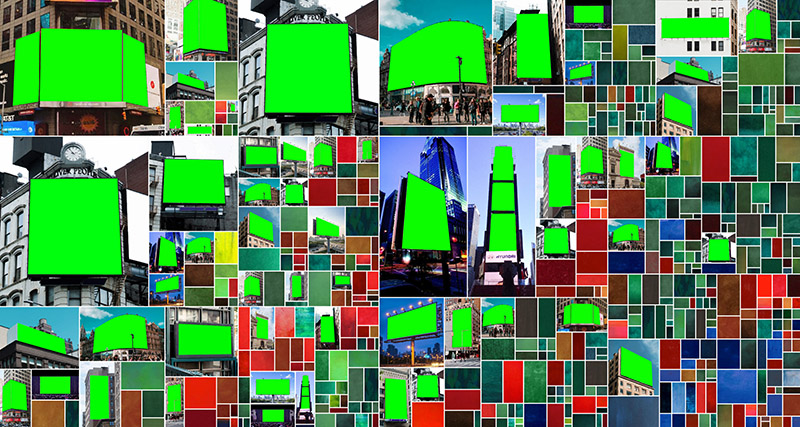
Ticker Wave, 2024 by Young Kim
Quantom Dot
The Quantum Rituals of the Ticker and the Future World.
WHAT THE BOOK EXPLORES
Quantum Dot: The Quantum Rituals of the Ticker and the Future World explores what it means to exist in an age where observation becomes participation, where data becomes experience, where every value is measured and every existence entangled.
The book follows multiple threads: art history, quantum physics, market psychology, existential philosophy. It weaves them into a meditation on consciousness in the digital age. It begins with the collapse of the traditional ticker and its false promise of predictability. It traces the evolution of the square from Malevich’s Black Square to the pixel, the data point, the quantum dot. It examines how markets operate as quantum systems, how human consciousness exhibits quantum properties, how the act of observation creates the reality it appears to measure.
THE QUANTUM DOT CONCEPT
The quantum dot serves as both physical phenomenon and philosophical concept. In physics, it is a semiconductor nanocrystal where quantum effects become visible. In this book, it becomes the minimum element of reality: the indivisible unit where continuous flux crystallizes into discrete moment, where observation collapses infinite possibility into singular actuality.
Every frame of Ticker Art is one quantum dot. Every trade in the market is one quantum dot. Every breath you take is one quantum dot. And you yourself are one quantum dot, not reduced to insignificance, but recognized as a point within the whole, where the part reflects the totality, where your existence transforms the system you observe.
THE STRUCTURE
Part I explores the birth of Ticker Art through existentialism, quantum observation, market psychology, and the ethics of creation. Part II grounds the practice in art history, from Malevich to Minimalism, from Rothko to AI color generation, and examines the network infrastructure that makes collective observation possible. Part III defines the quantum dot as ontological concept and traces how quantum thinking structures markets, identity, climate, and artificial intelligence.
THE INVESTIGATION
The book investigates how twentieth-century existential freedom collapses under algorithmic prediction. How Jean-Paul Sartre’s lonely self dissolves into networks of entanglement. How uncertainty persists even in total measurement. How the unmeasurable remains the last refuge of human dignity.
Through case studies (the 2010 flash crash, the GameStop squeeze, Cambridge Analytica, the COVID market collapse) it shows how collective observation creates reality rather than recording it. Through philosophical analysis, it argues that we are not isolated individuals but entangled existences, participating in the continuous creation of the world we inhabit.
A NOTE FROM THE AUTHOR
While writing this book, I watched Ticker Art every day. When markets opened each morning, the screen awakened, and colors began to surge. I watched it while drinking coffee, not trying to analyze, just watching.
Some days, green spread outward. Some days, red bled across. Some days, the two battled. But every day, without exception, there was never the same screen as yesterday. At first, I thought this was about markets. But as I wrote, something else began to appear. The market was a pretext. The real subject was time. That which flows, that which never returns, that which exists only in this present moment.
Studying Malevich’s Black Square, I understood why he reduced form to pure geometry. But I also saw his limitation. His square reached toward eternity, but there is no eternity. There is only a succession of moments. Ticker Art begins where Malevich stopped: releasing the square into time.
Studying quantum mechanics as an artist, not a physicist, incompletely, probably with misunderstandings, I learned why observation cannot be neutral. To see is not to receive but to participate. Measurement does not record reality; it creates reality. This was the structure of existence. And I realized: what I do standing before Ticker Art is exactly that. I am not watching the market. I am experiencing that I myself am part of the market, that my attention, my interpretation, my presence is one of the quantum dots constituting this moment’s reality.
There is a reason quantum dot appears in this book’s title. In physics, quantum dot has a specific meaning: semiconductor crystals nanometers in size. But in this book, quantum dot carries a broader meaning. It is the minimum element, the indivisible unit, the point where continuous flux crystallizes into discrete moment.
Every frame of Ticker Art is one quantum dot. Every trade in the market is one quantum dot. Every breath you take is one quantum dot. And you yourself are one quantum dot. This is not reduction. This is recognition, that you are a dot within the whole, that this dot reflects the whole, that this dot’s existence transforms the whole.
This book took a long time to write. During that time, the world changed. AI began to paint, cryptocurrency soared and crashed, a pandemic stopped the world and started it again. Some sentences I first wrote have already aged, and more will age in the future. But some things will not age. That time flows. That moments do not return. That we are connected to each other. That seeing is participating. That uncertainty cannot be eliminated. These are not technologies but structures of existence.
Ticker Art is merely one way to make this structure visible. Not the only way, perhaps not even the best way. But now, in this era, in this moment when data overflows and attention is scarce and time accelerates, Ticker Art is one proposal: Stop. Look. Recognize that what you are watching includes you.
I have a request for the reader. Do not finish by reading this book. Experience Ticker Art. Stand before the screen, for at least ten minutes, doing nothing, just watching. Watch the colors change. Watch the forms expand and contract. Whatever thoughts arise, let them be. Whatever emotions emerge, just feel them.
Then ask yourself: What did I see? What did I feel? What does this say to me?
Finally, a confession. I changed while writing this book. The way I see markets changed. I can no longer forget that behind the numbers lie the hopes and fears of millions. The way I experience time changed. I know now, not as theory but as sensation, that this present moment is the only moment. The way I understand myself changed. I am not a separate individual but a dot in a network, and that network observes itself through me.
So this book is not complete. No book is complete. A book is one quantum dot, existing only in the moment when the author’s time meets the reader’s time. Right now, as you read these words, in this moment, we are briefly entangled. My thoughts affect your consciousness, and your interpretation transforms my intention.
This is the structure of all communication. This is the structure of all relationship. This is the structure of existence.
A quantum dot. Watching itself. Briefly. Then vanishing.
Palos Verdes, 2026
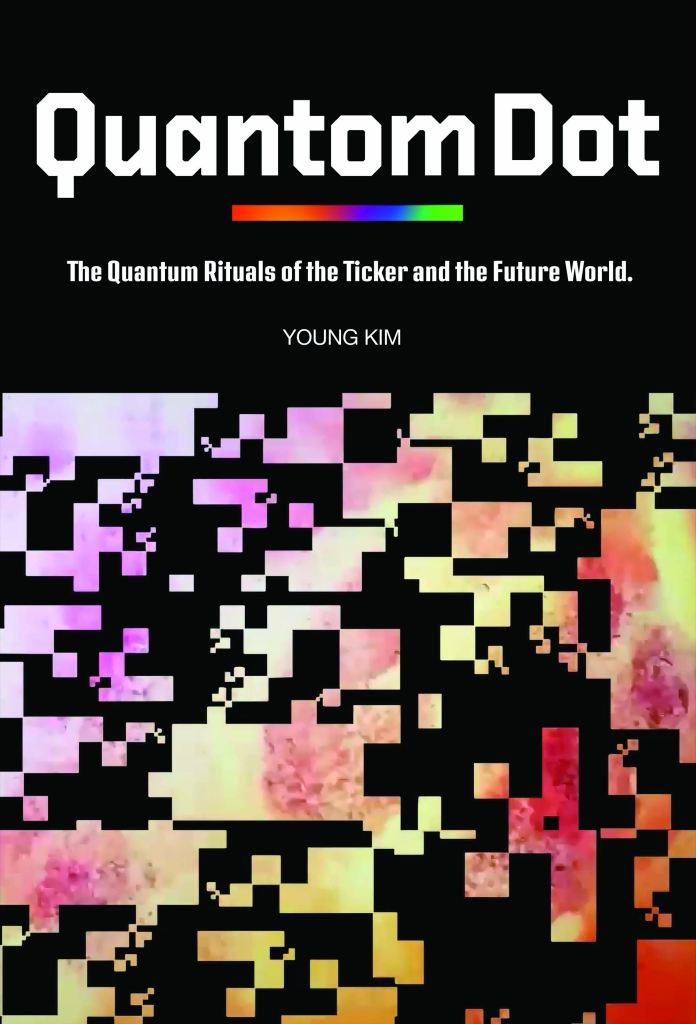
Quantum Dot, Young Kim 2025 (421 page)
A Word from the Artist
“TickerArt is not about the market, nor about numbers alone. It is about how humans remain human in an age where every value is measured, every act observed, and every existence entangled. Through volatility and noise, I seek to reveal the fragile but irreducible dignity of being human.”
— Young Kim